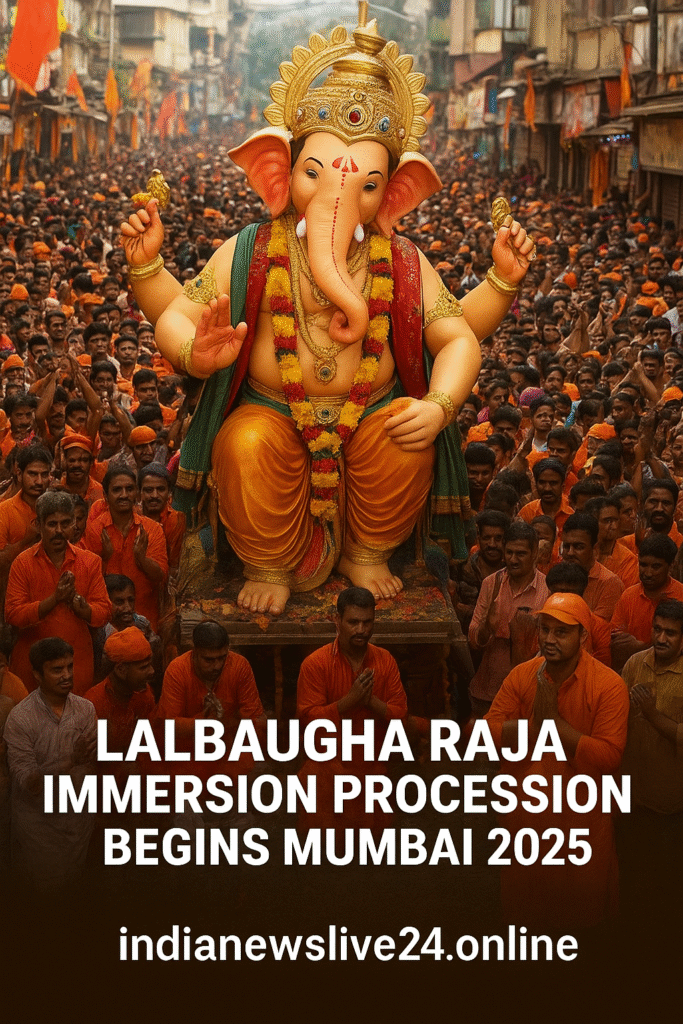
Mumbai once again witnessed its most awaited and emotional farewell as the grand immersion procession of Lalbaugcha Raja, the city’s most iconic Ganpati idol, began with unparalleled devotion and fanfare. The streets of Lalbaug and beyond were painted in shades of faith, joy, and unity as lakhs of devotees joined in to bid adieu to their beloved Bappa on the occasion of Anant Chaturdashi.
This year’s procession, like every year, was nothing short of a cultural spectacle. The 92-year-old idol, revered as the “Wish-Fulfilling Ganpati,” was adorned in traditional attire with resplendent ornaments, making it a majestic sight for all. Devotees thronged the pandal and lined up along the route, chanting “Ganpati Bappa Morya” as the idol slowly made its way through Mumbai’s crowded streets toward Girgaon Chowpatty for immersion in the Arabian Sea.
For over nine decades, Lalbaugcha Raja has been more than just an idol—it has been an emotion for Mumbai. Born out of the hopes of traders and fishermen in 1934 after their marketplace was shut down, the idol has remained a symbol of resilience, gratitude, and unbreakable community spirit. Over time, it has become the beating heart of Ganesh Chaturthi celebrations across the country.
One of the most remarkable aspects of this grand procession is its inclusivity and deep-rooted traditions. Each year, the idol halts at the Hindustani Masjid in Byculla, a gesture that has transformed into a symbol of interfaith unity. At the mosque, Muslim residents welcome the idol with flowers and sweets, extending their goodwill to the sea of devotees. This moment, cherished by both communities, reflects Mumbai’s unique fabric of harmony and mutual respect. It is a tradition that has continued for decades, strengthening bonds across religious lines and standing as a beacon of peace in times of division.
Apart from the emotional stop at the masjid, the procession also saw its iconic halt at the Shroff Building, where the ritual of Pushpavrishti (showering of flowers) took place. As flowers rained down on the idol, devotees were left in awe of the divine spectacle. The lanes of Lalbaug echoed with music, dhol-tasha, and joyous chants, transforming the entire area into a spiritual carnival.
This year also witnessed the presence of prominent personalities. Isha Ambani, dressed in a vibrant blue suit with intricate golden embroidery, visited Lalbaugcha Raja along with her children to seek blessings before the immersion. Her graceful appearance with her family was a blend of modern elegance and traditional devotion, resonating with countless devotees who look at the Raja as an anchor of faith in their personal and professional lives.
The immersion journey of Lalbaugcha Raja is not just a religious procession but also a logistical marvel. Stretching over 20 hours, the route passes through some of Mumbai’s busiest areas—Lalbaug Market, Byculla, Chinchpokli, Delisle Road, Nagpada, and finally, Girgaon Chowpatty. Despite the mammoth crowd, volunteers, organizers, and Mumbai police work tirelessly to ensure safety, discipline, and smooth movement. It is a fine example of how the city comes together, leaving aside daily chaos, to celebrate devotion.
For devotees, darshan of Lalbaugcha Raja itself is an unforgettable experience. The pandal offers two lines: the Navsachi Line, where people can touch the idol and make their heartfelt wishes, and the Mukh Darshan Line, where devotees can take blessings from afar. While the Navsachi Line often takes days of waiting, devotees willingly endure it, believing their prayers will be answered. The tradition of wish-fulfillment has given Lalbaugcha Raja his legendary title.
Even those who cannot visit in person connect through live streams and social media. Millions across India and abroad tune in online to witness the grandeur, proving how the festival transcends physical boundaries and unites devotees worldwide.
The immersion itself is a deeply symbolic ritual. As the idol is lowered into the waters of Girgaon Chowpatty amid loud cheers, tears, and chants, it signifies the cycle of life—birth, sustenance, and dissolution—reminding devotees of detachment and renewal. It is an emotional moment where faith and farewell intertwine, leaving behind an emptiness that will only be filled when the Raja returns the following year.
This year, the visarjan procession also carried messages of environmental responsibility. Authorities and NGOs spread awareness about eco-friendly practices, urging devotees to celebrate with devotion while also respecting nature. With Mumbai battling rising sea pollution, the call for eco-friendly idols and sustainable celebrations grows louder each year.
But beyond its religious and environmental significance, Lalbaugcha Raja’s visarjan highlights something deeper—the resilience and unity of Mumbai. The grand halt at Hindustani Masjid reflects the city’s soul: a place where traditions are respected, differences are celebrated, and faiths coexist. In a world often divided, such moments of togetherness remind us that Mumbai’s greatest strength lies in its harmony.
As dawn breaks after the immersion, devotees return with hearts heavy yet hopeful. They know the farewell is temporary, for Lalbaugcha Raja will return next year to bless them once again. Until then, the chants of “Ganpati Bappa Morya, Pudhchya Varshi Lavkar Ya” echo across Mumbai, carrying faith, hope, and anticipation into the coming year.
The 2025 visarjan of Lalbaugcha Raja was not just an immersion of an idol—it was an immersion of emotions, traditions, unity, and devotion into the soul of a city that never stops believing.