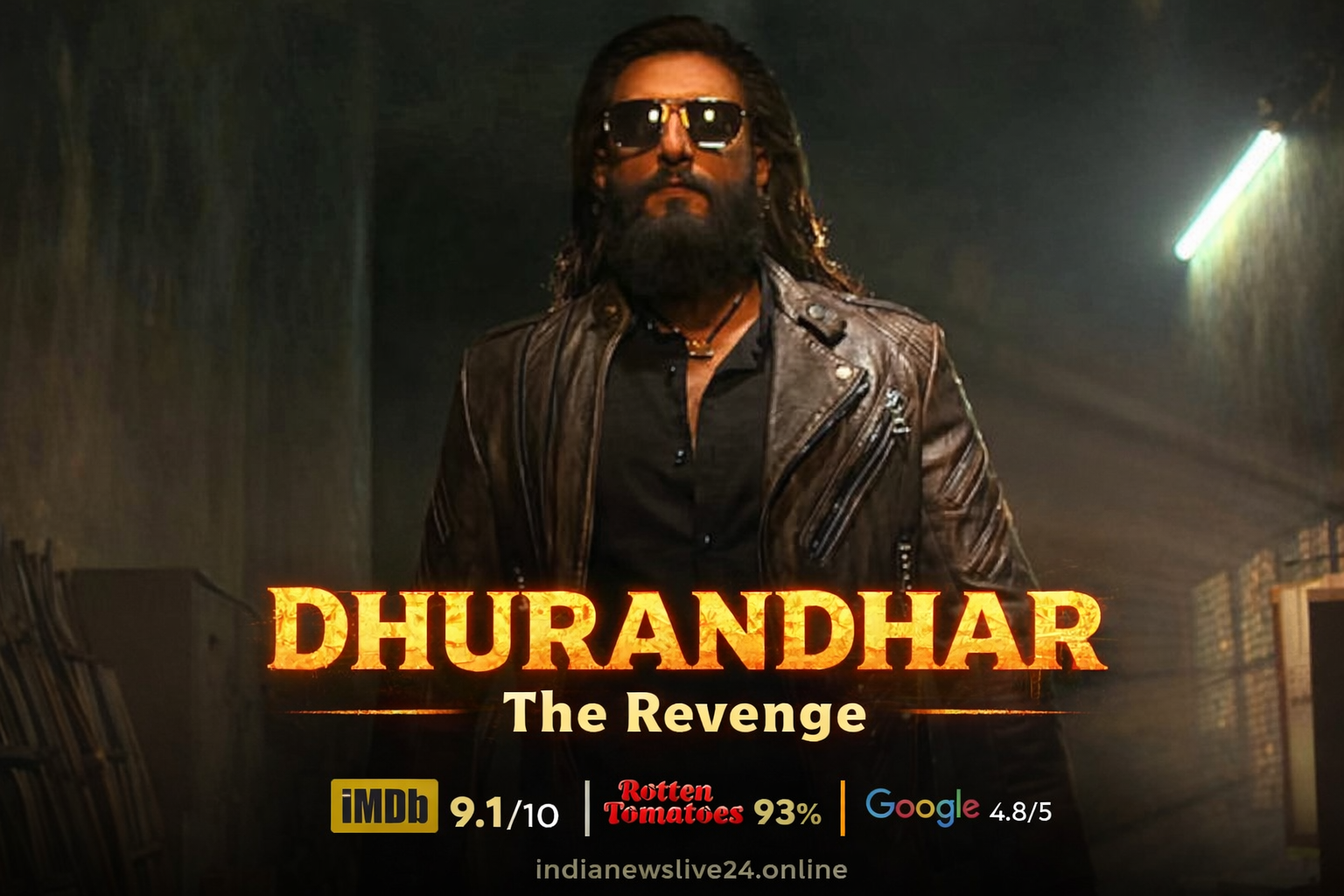
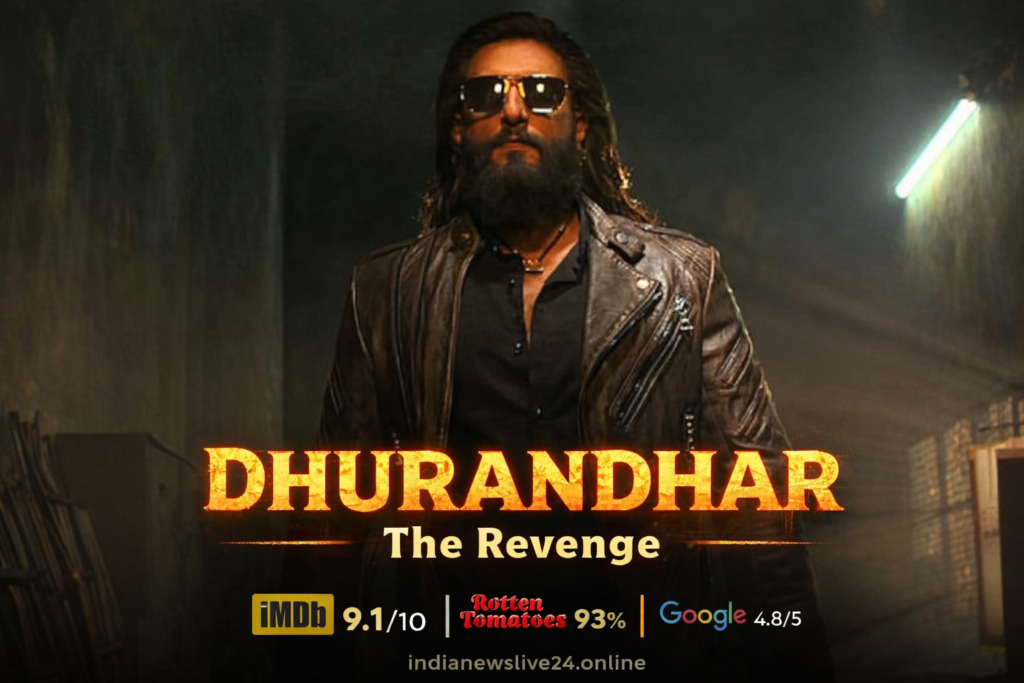
Rating: 4.5 / 5 | Released: March 19, 2026 | Runtime: 3 hrs 49 min | Director: Aditya Dhar
“Some Films Don’t Just Entertain You — They Change You.”
The last time India experienced a cinematic storm of this magnitude was when Baahubali posed its legendary question and kept the entire nation sleepless for two years. Dhurandhar: The Revenge — the long-awaited second chapter of director Aditya Dhar’s sprawling spy duology — arrives in theatres today with the weight of an entire nation’s expectations pressing down on it. And remarkably, thrillingly, it does not buckle.
Released on March 19, 2026 — timed auspiciously with Gudi Padwa and Ugadi — this film is not merely a sequel. It is a reckoning. It is the fulfillment of a promise made in a post-credits scene in December 2025 that sent chills down the spines of millions. Without exaggeration and without hesitation: Dhurandhar: The Revenge is one of the finest sequels Indian cinema has ever produced.
The Story So Far — And What Comes Next
For those who need a refresher: the first Dhurandhar (released December 5, 2025) followed Jaskirat Singh Rangi — brilliantly portrayed by Ranveer Singh — as an ordinary young Sikh man recruited by Indian intelligence and transformed into a covert operative named Hamza Ali Mazari. Operating deep in the underbelly of Karachi, the first part established the world, the stakes, and the characters with pinpoint precision, weaving in real-life geopolitical flashpoints including the 1999 IC-814 hijacking, the 2001 Parliament attack, and the devastating 2008 Mumbai bombings.
The Revenge picks up exactly where the first film ends. Hamza has now embedded himself deep within the Karachi underworld of Lyari, his identity a razor-thin veil stretched between survival and death. The world grows grittier, the stakes taller, the antagonists more dangerously layered. The film’s opening chapter — titled The Burnt Memory — establishes an emotional wound at the story’s core that will keep bleeding quietly beneath every subsequent action sequence and interrogation scene until it finally tears wide open in one of the most devastating third acts in recent memory.
The central tension of The Revenge is devastatingly simple: after every thirty minutes on screen, you sit gripped by the terror that Hamza’s cover will be blown. Every handshake, every conversation, every accidental glance carries lethal weight. This is not action cinema as spectacle — it is action cinema as sustained psychological dread, punctuated by eruptions of visceral, bone-crunching violence that hit like a slap every single time.
Performances — An Ensemble That Burns
Ranveer Singh has always been one of Bollywood’s most electric presences. But what Aditya Dhar has drawn out of him here is something quieter, harder, and far more dangerous. In The Revenge, Ranveer sheds every trace of the flamboyance that has defined his public persona. He portrays Hamza as a man hollowed out by years of deception, running purely on conviction and controlled fury. When that fury finally detonates in the film’s back half, the screen barely contains it.
Sanjay Dutt’s cartoonishly menacing antagonist dominates the first half as the looming villain. The role leans into a larger-than-life caricature, yes, but Dutt owns every scene with the confidence of a man who knows precisely what audiences want from him. Then Arjun Rampal’s Major Iqbal steps forward — cold, calculating, a predator operating through precision rather than noise — and the film shifts register entirely. The scene in which Iqbal confronts his father is one of the most unexpectedly affecting moments in recent Indian cinema. Rampal holds the frame for ten extraordinary minutes and refuses to let go. It is the kind of performance that makes you wonder why this actor hasn’t been handed material like this much sooner.
R. Madhavan’s Ajay Sanyal remains the quiet heartbeat of the film. Restrained yet powerful, Madhavan communicates volumes with a single look across a conference table. Akshaye Khanna brings his trademark cold authority to the intelligence establishment, and Rakesh Bedi — widely praised as a surprise package in the first film — returns as Jameel Khan with a pivotal arc that expands in genuinely unexpected directions.
Direction & Craft — A Vision Growing Sharper
Aditya Dhar is now, without question, a brand unto himself in Indian cinema. The backstory of how The Revenge came to exist is itself telling: Dhar shot over seven hours of footage and chose to release it across two three-and-a-half-hour chapters, convinced that only this format would honour the richness of the material and the ensemble he had assembled. That gamble has paid off spectacularly.
The film runs nearly three hours and fifty minutes, and the most astonishing thing is that it never once feels its length. The chapter-based storytelling from the first film is retained and refined, giving the narrative a propulsive, episodic rhythm that keeps audiences locked in even through the quieter dialogue-heavy stretches. Where lesser directors would have reached for flashier cuts and louder music to mask narrative slack, Dhar trusts his story and his cast — and the trust is returned in full.
The screenplay is meticulous in the way it layers information. Details planted casually in the first hour return in the third as gut-punch revelations. Character motivations that appear simple reveal hidden depth. The geopolitical backdrop — drawn from documented historical events — gives everything an urgency that no fictional thriller can manufacture. You know some of what is coming because history tells you so, and yet you watch through your fingers anyway.
Cinematography, Music & Sound — A Sensory Triumph
Vikash Nowlakha’s cinematography adopts a palette darker and more intense than the first film. Night sequences drenched in shadow, rain-soaked confrontations, and interior scenes lit with dramatic contrast all serve to amplify the film’s sense of perpetual danger. Unlike many large-scale Bollywood productions where the camera becomes frenetic during action, The Revenge holds its nerve — steady and immersive, lending every confrontation tactical clarity without sacrificing adrenaline.
Shashwat Sachdev’s background score is not an accompaniment — it is a co-conspirator. The score pulses and surges like a living thing, pounding through the action and then dropping to something haunting and elegiac in the emotional lulls. The reintroduction of the Aari Aari track — drawn from a beloved Punjabi pop classic and reimagined for this universe — is deployed with perfect dramatic timing, its chest-thumping energy arriving exactly when the film needs to remind you why you came.
The film was shot across Punjab, Chandigarh, Maharashtra, Ladakh, Himachal Pradesh, and Thailand, with many of these areas doubling for Pakistan-set sequences. The production design team has created a Karachi underworld that feels tactile and lived-in — a far cry from the sanitised, CGI-heavy backdrops that plague lesser films in the genre.
Box Office — India Is Watching
Even before a single regular-show ticket was torn, The Revenge was already rewriting Indian cinema’s record books. Paid preview collections alone crossed ₹50 crore gross — shattering the previous premiere record by an almost incomprehensible margin. In worldwide advance sales, the film crossed ₹200 crore, making it only the fifth Indian film ever to achieve this and the first Bollywood production to join that exclusive club alongside Pushpa 2, RRR, and Baahubali 2.
On BookMyShow, the film has sold over 1.3 crore tickets, surpassing Shah Rukh Khan’s Jawan to become the highest-selling Hindi film in the platform’s entire history. The original Dhurandhar was simultaneously re-released across 1,000 screens globally on March 13 — the first time in Indian cinema that a prequel continued running all the way into its sequel’s theatrical life. The audience appetite for this universe is, simply put, unprecedented.
Final Verdict
Some critics will call Dhurandhar: The Revenge propaganda — a film drenched in patriotic fervour, built upon real national tragedies, designed to stoke emotions. These are fair and important conversations. But the film never simplifies its characters into cardboard archetypes. The antagonists have logic. The hero has wounds. The world depicted is morally messy and painfully real. It earns its emotion the hard way.
What Aditya Dhar has built — across both films — is an act of extraordinary cinematic ambition. He has trusted his audience to sit with nearly eight hours of complex, layered storytelling across two chapters, and that trust is repaid in full. Dhurandhar: The Revenge is tightly written, relentlessly paced despite its length, and loaded with moments that will have you gripping your armrest, swallowing hard, and occasionally reaching for someone’s hand in the dark.
Heed the director’s own words: do not leave your seat until the credits have fully stopped rolling.
Dhurandhar: The Revenge is not just the best Bollywood film of 2026. It is a landmark of Indian cinema. Watch it on the biggest, loudest screen you can find.
Director: Aditya Dhar | Cast: Ranveer Singh, Sanjay Dutt, Arjun Rampal, R. Madhavan, Akshaye Khanna, Yami Gautam, Rakesh Bedi | Music: Shashwat Sachdev | Rating: A (Adults) | Runtime: 3 hrs 49 min